Action Beats Perfection, and I Can Prove It
I'm a recovering perfectionist.
For most of my career, my way of getting things done looked like this: plan for a long time, think through every angle, picture how it would all go... and then, finally, act.
It felt responsible. It felt smart.
It was slow, and it was wrong more often than I'd like to admit.
I'd heard "done is better than perfect" a thousand times. I agreed with it. It didn't change a thing.
What finally changed it was proving it to myself, the way an engineer would.
You are a control system
In engineering, a control system is anything that tries to hit a target: a thermostat holding a room at 70 degrees, cruise control holding a car at 65, an autopilot holding a plane on course.
Every control system has a controller, the part that decides what to do next. And there are two basic kinds.
Open loop. The controller decides everything up front, acts, and never checks the result. Think of an old toaster: it runs for two minutes whether your bread is burning or not.
Closed loop. The controller acts, measures what happened, compares it to the goal, and adjusts. Then it does it again. That's your thermostat, and it's why your house doesn't swing between freezing and boiling.
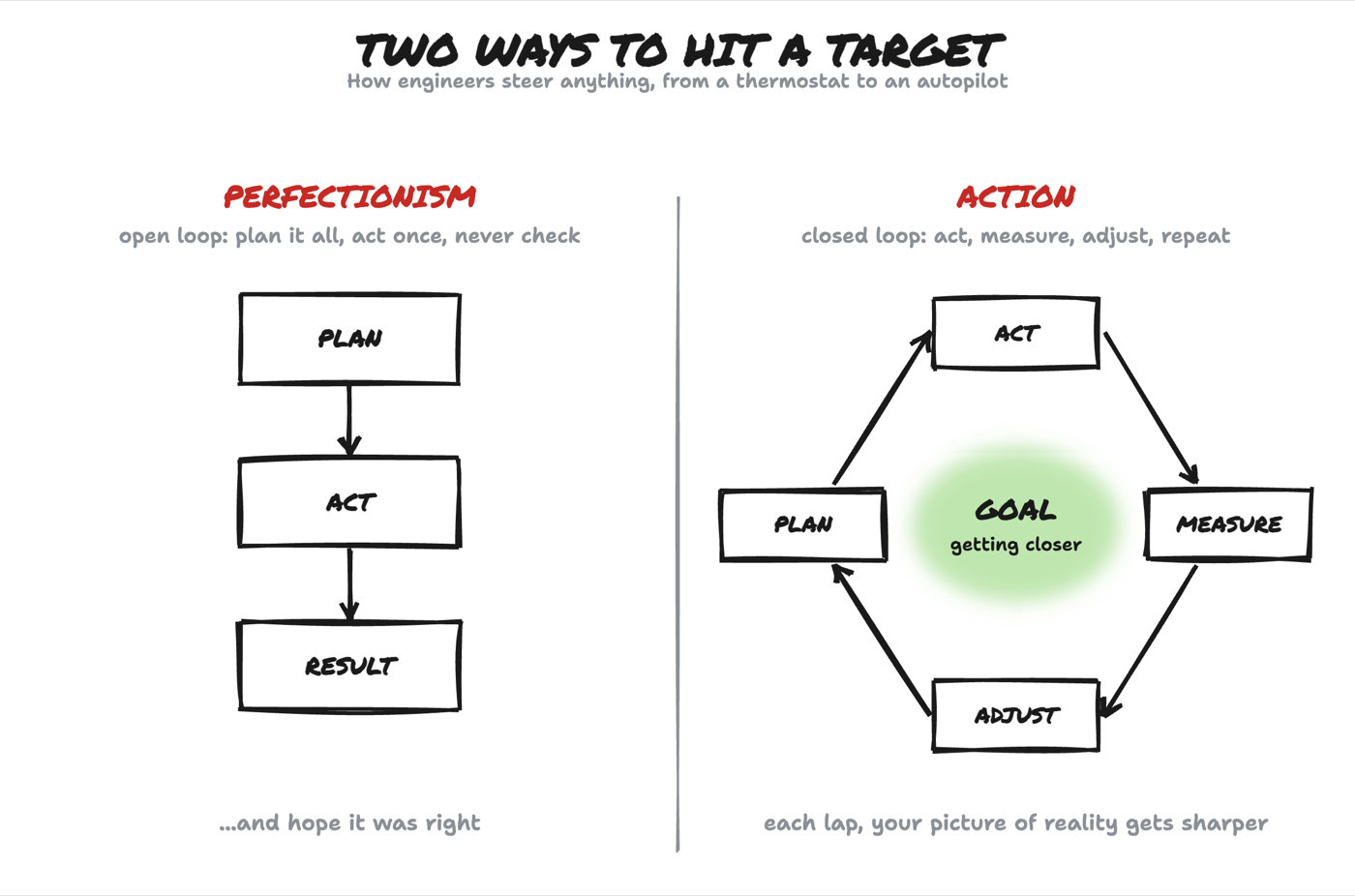
Here's what I realized: perfectionism is an open-loop controller.
You build a model of the world in your head. You plan around what that model predicts. Then you act, with no feedback, or with feedback that takes months to arrive.
The problem is that the model in your head is always wrong in ways you can't see. And an open-loop controller has no way to find out.
Taking action with fast feedback is a closed-loop controller. Every action tells you something real, and every lesson makes your model a little more accurate.
Engineers settled this debate a long time ago. For anything complex, where you can't predict exactly how things will play out, closed loop wins. James Clerk Maxwell wrote the first mathematical paper on feedback controllers in 1868, and closed-loop control now runs nearly everything around us.
A business is about as complex as systems get.
Thinking runs out of information
The second piece comes from information theory, the math Claude Shannon developed for measuring information.
In that world, information is whatever reduces uncertainty. The less sure you are about something, the more a new piece of information is worth.
So where does new information come from?
Thinking produces some. At first, it's genuinely valuable. You spot obvious problems, weigh your options, and make a plan.
But thinking can only rearrange what you already know. It can't produce the information you don't have: how customers will actually react, what will break, what you didn't know to ask. The value of each extra hour of thinking drops fast.
Action keeps producing new information. Every attempt, even a failed one, tells you something you couldn't have figured out in your head.
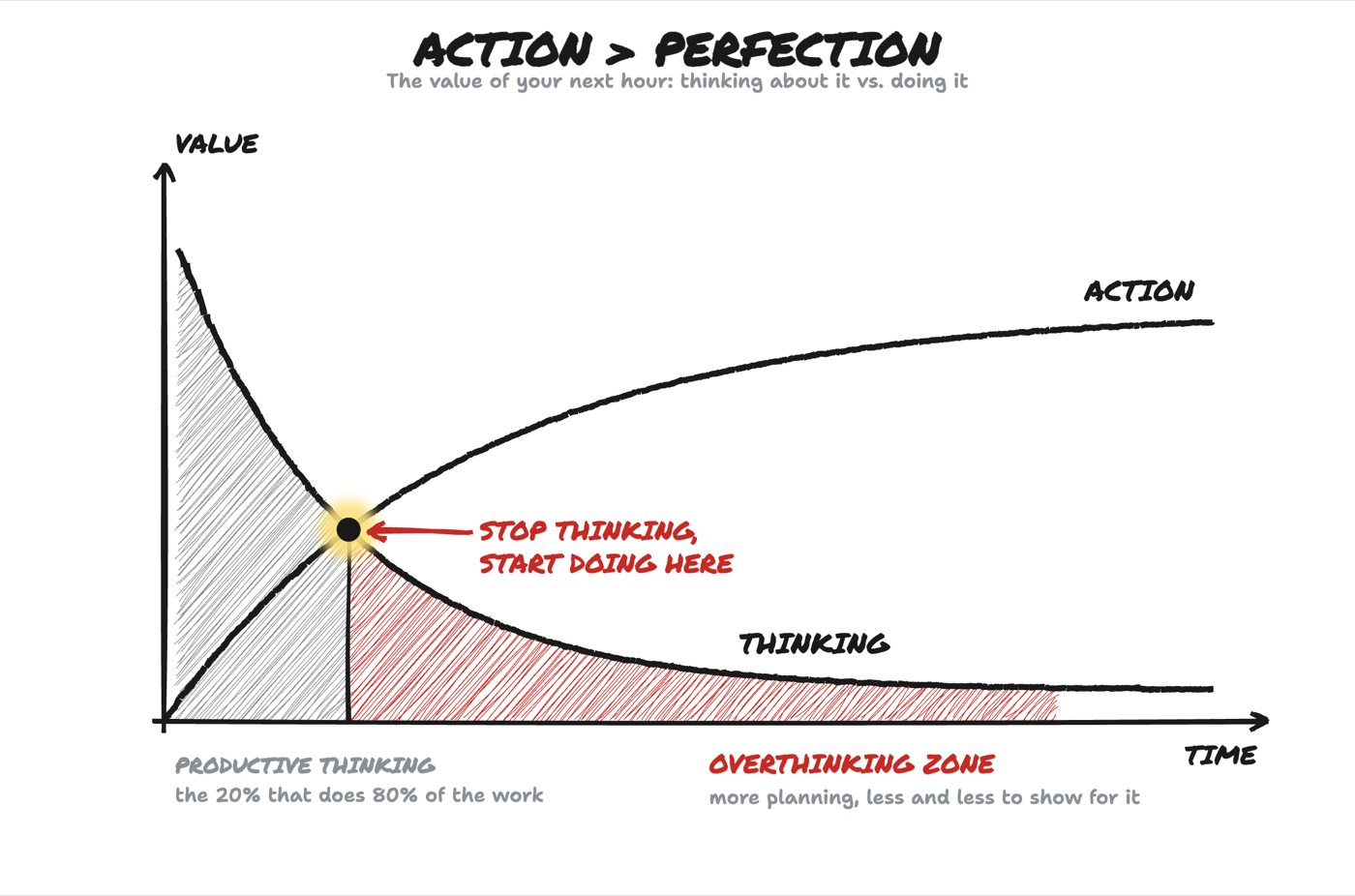
Early on, thinking is the better investment. That's the gray zone on the left. A little planning goes a long way.
But the two curves cross. Past that point, every extra hour of thinking is worth less than an hour of doing. That's the red area: the overthinking zone.
And it's worse than it looks, because every hour in there also carries an opportunity cost. The market moves. The window closes. Someone else ships.
So the skill isn't "never plan." It's knowing where the curves cross, and moving the moment you get there.
It's also how machines learn
The third piece surprised me the most.
Modern AI learns the same way.
A neural network, the kind of model behind today's AI, starts out making bad predictions. It makes one anyway. It measures how wrong it was. It adjusts itself a little to be less wrong. Then it repeats that loop millions of times.
It doesn't sit and think about the perfect answer first. It acts, gets feedback, and adjusts.
That loop is how every modern AI system learned what it knows. And it's roughly how our own brains learn too: through repetition and correction, not contemplation.
The research agrees
Researchers who study how people make decisions keep landing in the same place.
Gary Klein found that experts in high-pressure jobs mostly decide by drawing on experience from past action, not by weighing every option. Amy Edmondson found that teams willing to act and learn from mistakes tend to outperform teams that stall in planning. And John Boyd, a fighter pilot, built the OODA loop (observe, orient, decide, act) because in a dogfight, the pilot who cycles fastest wins.
What I changed
Action beats perfectionist planning because it produces useful information faster. And better information leads to more reliable results.
But notice the condition: action with feedback. This isn't an argument for acting blindly. Action without feedback is just another open loop.
So I rebuilt my own controller:
- Plan until the plan stops getting better, then act. Not after.
- Put a feedback loop on everything. If I can't measure the result, I'm not really learning.
- Make the loops short. The faster you go around, the faster your mistakes shrink.
- Treat a miss as information, not failure. It's the loop doing its job.
It turns out the cure for perfectionism wasn't trying harder to let go.
It was understanding, mathematically, why the perfect plan was never going to come from my head.