AI Brings Back One-to-One Marketing
Every big leap in marketing history has had one thing in common.
It got us a little closer to a one-on-one conversation.
AI is the first technology that can take us all the way there.
Where marketing started
Two hundred years ago, nearly every sale was one-on-one. A merchant talked to a customer, listened, answered questions, and adjusted the pitch to that person.
That's still the most effective way to sell. Even an average salesperson on a call closes far more often than the best sales page. They can hear what this one person cares about, and respond.
The problem is it doesn't scale. One salesperson can only talk to so many people.
One-to-many
Then came the printing press, and later the telephone, radio and TV. For the first time, you could deliver one message to thousands of people at once.
The message got worse. It couldn't adapt to anyone. But the reach made up for it.
Then competition caught up. Just saying your product was good stopped working. Marketers had to learn how to persuade at scale: better copy, testing one version against another, measuring what worked.
That's how direct response marketing was born.
The internet, then the funnel
In the '90s, the internet changed everything again. Anyone with a connection and a few dollars could reach the whole world. I was a kid building websites, and so were thousands of others.
A simple web page could convert a percent or two of its visitors.
Then a few smart marketers took the old direct response principles online. Instead of one page, they built a series of steps that walked a prospect toward the sale, the way a good salesperson would.
That's the funnel, and it worked several times better than a single web page.
Then automation
Next came marketing automation. Instead of sending everyone down the same path, you could separate buyers from leads, and send different messages depending on what each person did.
Watched the video? Here's the next step. Didn't click? Here's a different angle.
Another big jump in results, because the experience got a little closer to one-on-one.
The pattern
Look at the whole history and the pattern is clear:
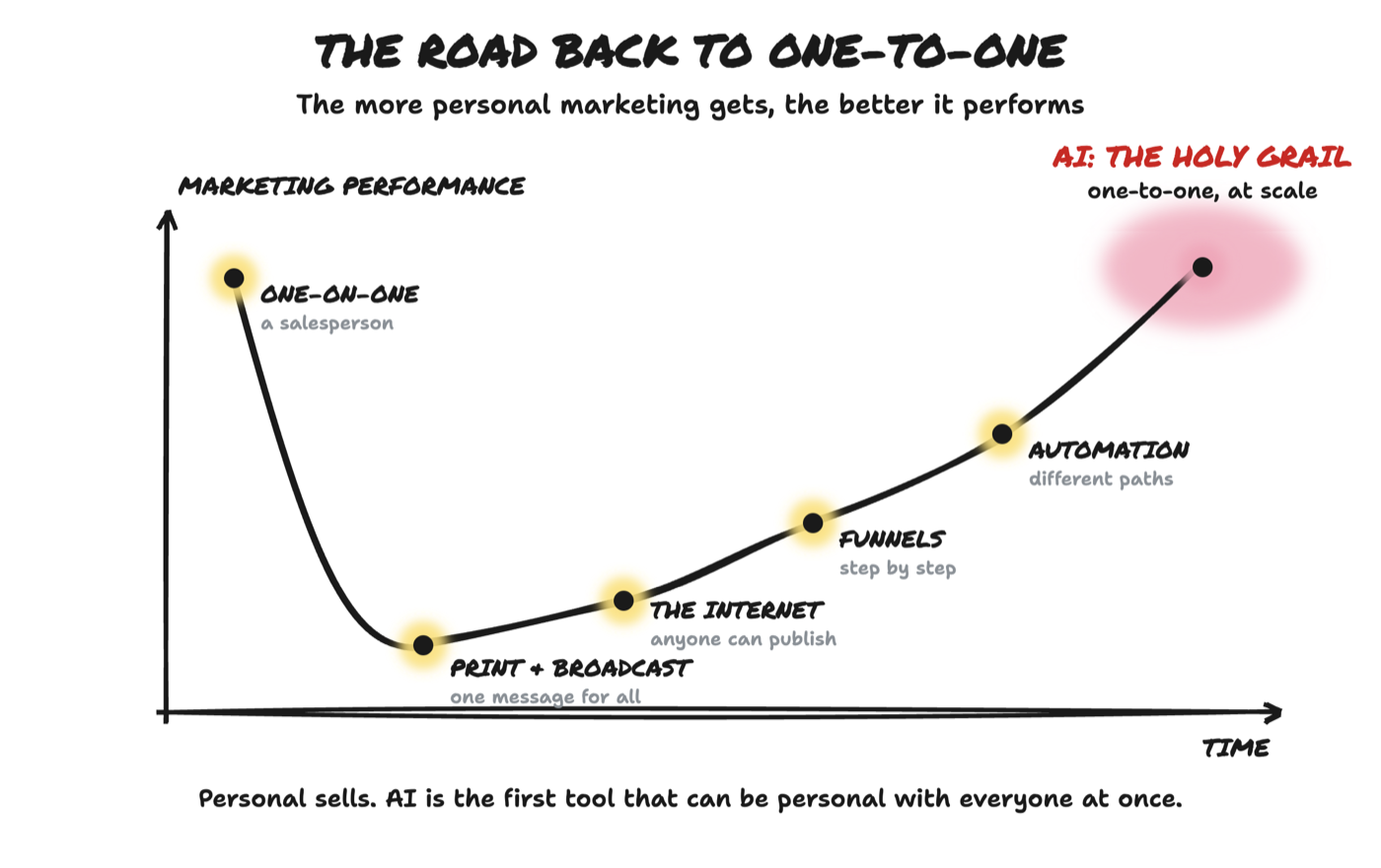
- Every leap was driven by a new technology.
- Every leap made marketing a little more personal.
- And every time it got more personal, results went up.
But we never got all the way back to one-on-one. It went from one-to-many, to one-to-fewer. True one-to-one was always too expensive.
Until now.
What AI changes
AI is the first technology that can respond to each person individually, at scale.
You've already seen it. Amazon recommends different products to you than to me. Your social feed is different from mine. That's AI adapting the experience to one person at a time, behind the scenes.
Until recently, only companies with billions of dollars could do that. Now almost anyone can.
And it goes further than recommendations.
Imagine a website that builds each page on the fly as you move through it, adapting to what you click, what you skip, and what people like you went on to buy. Not one landing page for everyone, or even a few versions for a few segments. A page built for you, while you're reading it.
Take that one step further, and the whole internet changes. Today, most of the web is an archive: someone wrote a page once, from their point of view, and everyone sees the same thing. AI makes it dynamic. When you ask for what you want, it doesn't search an archive and show you someone else's answer. It builds yours, right then.
The web stops being a library and becomes a conversation.
The holy grail
A one-on-one conversation, at the scale of the internet, has always been the holy grail of marketing.
For the first time, it's actually within reach.
The businesses that figure it out first will feel like they've hired a great salesperson for every single visitor.