No Teef: Why Every System Is Only as Strong as Its Weakest Link
So I grew up on the tropical Caribbean island of Trinidad & Tobago.
But even paradise has a way of teaching humility.
It happened on my first day of kindergarten...
where I quickly earned the nickname...
"No Teef!" :-)
...because I had a big gaping hole where my two front teeth were supposed to be!
Talk about embarrassing!
But even more embarrassing was HOW I lost my teeth.
You see...
I have two older brothers...
and one day, one of them declared, "Let's play tug-of-war!" and yanked an old bedsheet out of the linen closet.
Now somehow (and to this day, I can't explain why I agreed to this)...
my two MUCH STRONGER brothers challenged scrawny little me to play them, TWO against one!
You see where this is going...
3...2...1...PULL!
I dug in my heels, smiling, thinking I was holding my own!
...but the instant that thought came, it went. My five-year-old body lurched forward like a human slingshot, straight into a wooden doorframe, face first!
...with both of my baby teeth tumbling out of my mouth and onto the floor.
So what does losing my teeth have to do with anything?
Well, here's the thing...
On that day, without knowing it, I ran face-first into a universal force.
The same force is at work right now in your business, your team, and your daily routine.
In short, systems are only as strong as their weakest link!
In that tug-of-war, between the three of us, I was the weakest link. There was zero chance of the game ending any other way.
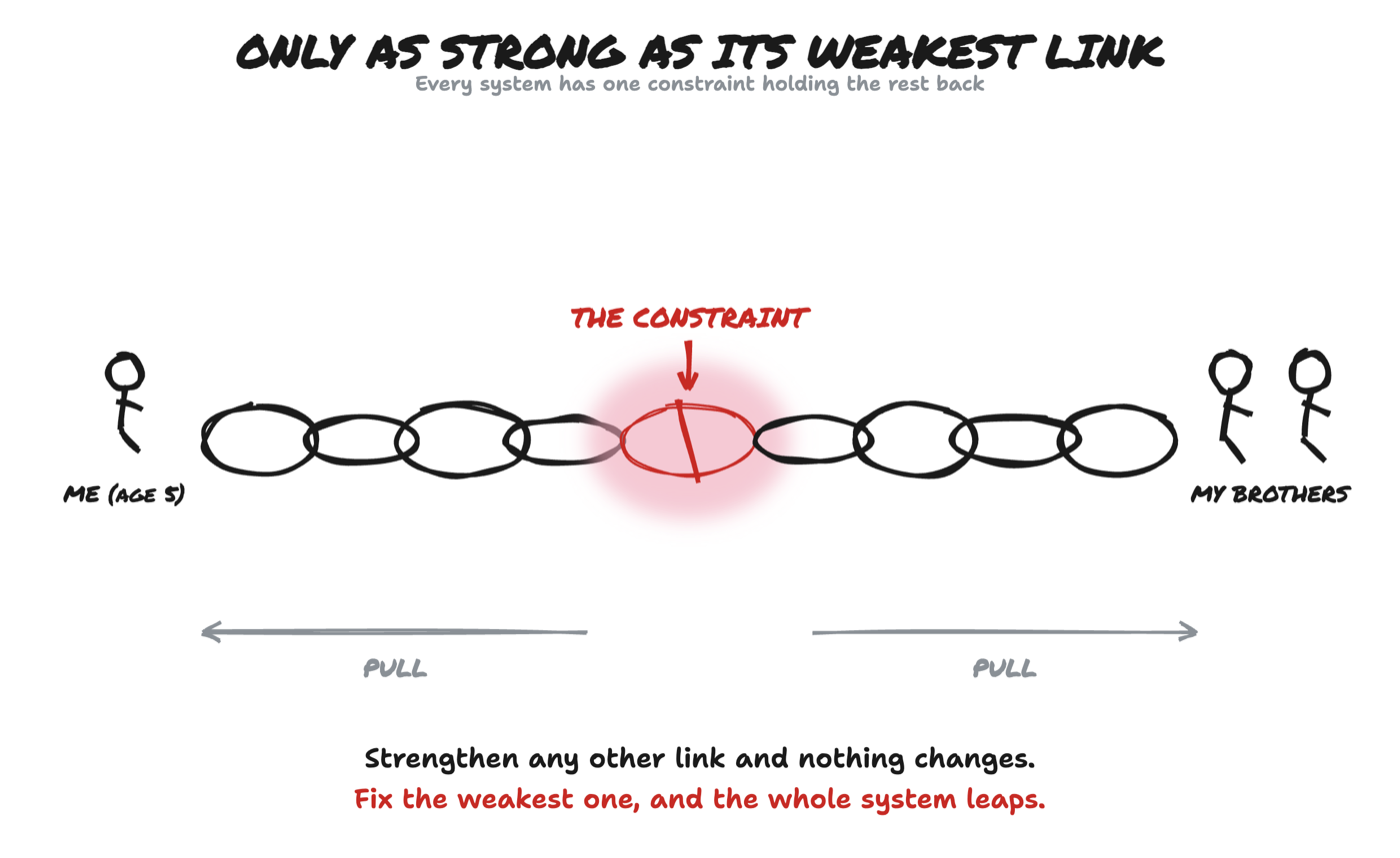
And it works the same way everywhere.
If your marketing funnel isn't performing (or your team, or your workday), there's a very good chance it's being held back by one constraint.
Not ten things. One.
Fix everything else, and almost nothing changes.
Fix that constraint, and the whole system takes a leap.
Finding your weakest link
Of course, the tricky part is spotting it. The constraint almost never announces itself. It hides in a sea of data while you spend months polishing the parts that already work.
Here's the simple way I look for it...
- Follow the flow. Trace the path from start to finish: stranger to customer, or idea to finished product.
- Find where things pile up or drop off. In a funnel, it's the step where most people leave. In your day, it's the task everything else is waiting on.
- Fix only that. Resist the urge to fix everything at once!
- Then look again. Once that constraint is gone, a new one becomes the weakest link. That means you're making progress.
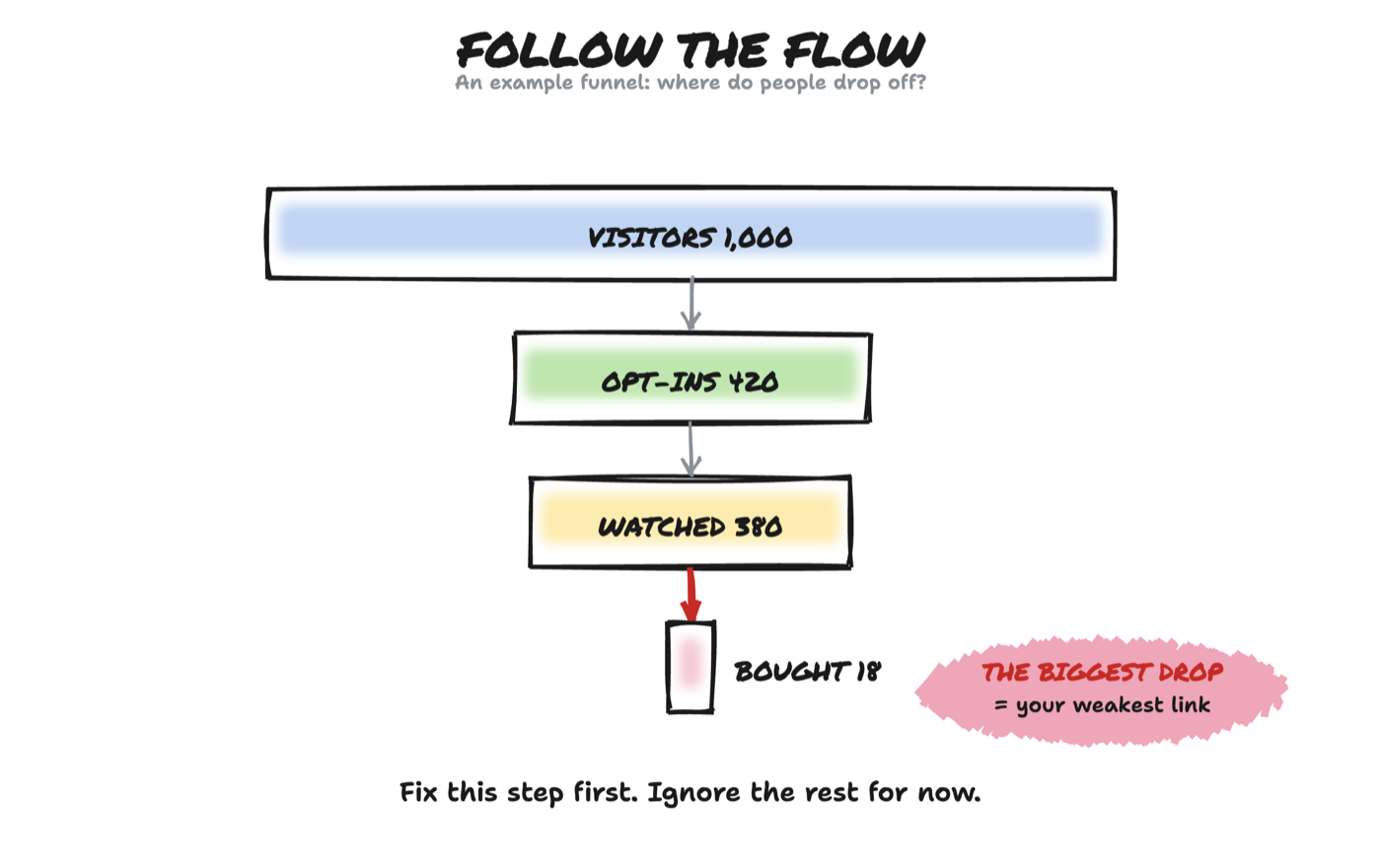
Do this over and over, and a struggling system slowly becomes a well-oiled machine.
I learned this lesson the hard way...
with a mouth full of gaps!
You get to learn it the easy way. :-)