Think Like an Agent
In the spring of 2025, I spent weeks learning how to build AI agents from scratch.
I expected to learn a new technology.
I didn't expect it to change how I think.
What an agent actually is
A chatbot answers one question and stops.
An agent is an AI that keeps going until the job is done. It makes a plan, uses tools (search the web, write a file, check a page), looks at the result, and decides what to do next. Then it loops.
The simplest way I know to describe it: an agent is a system with a built-in feedback loop.
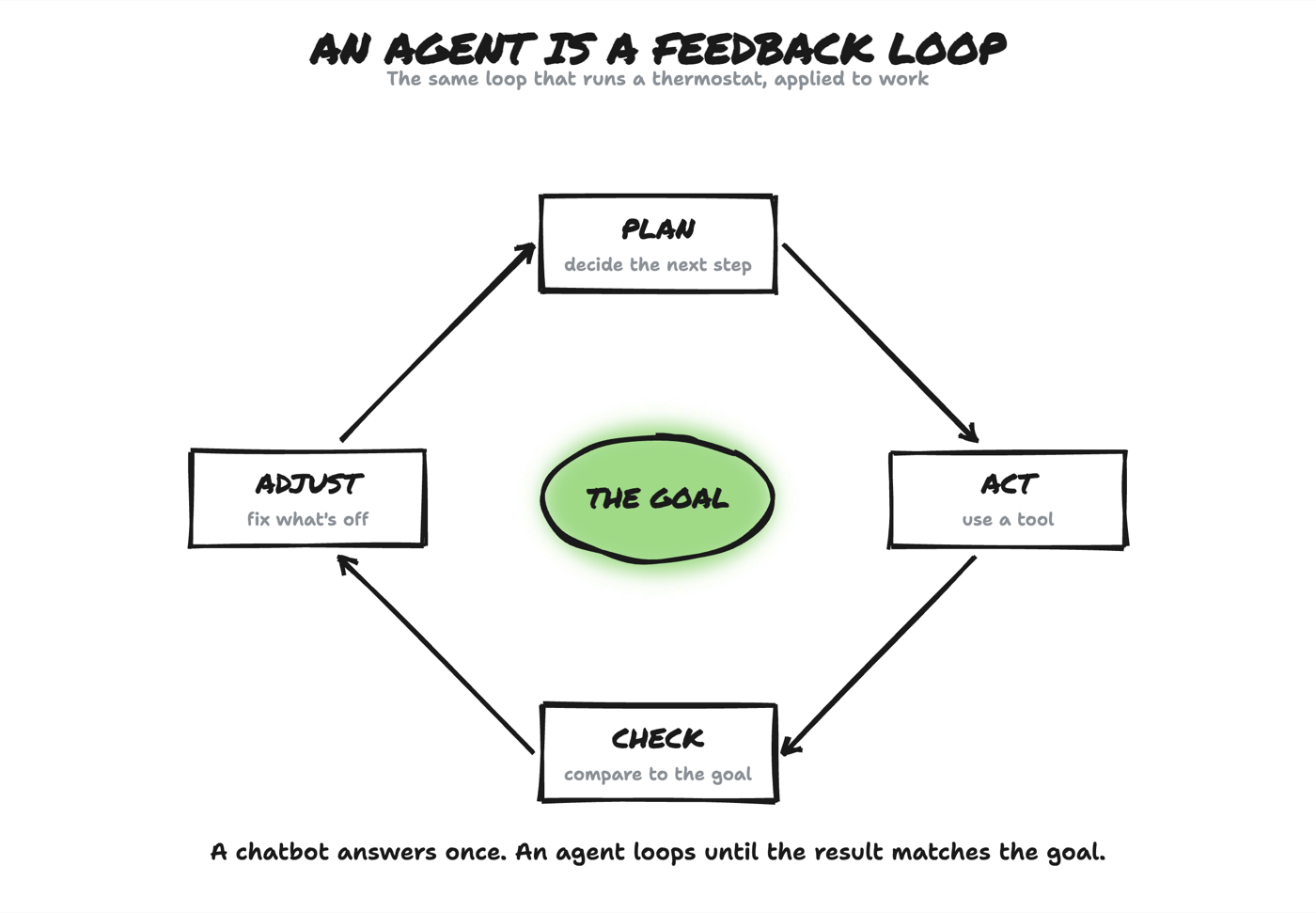
A feedback loop is what lets any system correct itself. Your thermostat has one. So does an airplane on autopilot. It measures where it is, compares that to where it should be, and adjusts.
An agent does the same thing with work. It checks its own output against the goal and keeps adjusting until they match.
The AI model itself, the part people call an LLM (large language model), is just one component inside that system. The loop around it is what makes it powerful.
The patterns are thinking tools
The engineers at Anthropic, the company behind Claude, published a guide to the handful of patterns that make agents work well.
As I read it, I kept noticing something. Every pattern was also a good way for a person to think:
- Prompt chaining: do one step at a time, in order, and pass each result to the next step.
- Routing: figure out what kind of problem this is first, then send it down the right path.
- Parallelization: attack the problem from several angles at once, then compare.
- Orchestrator and workers: break the big job into pieces, hand them out, then put the results together.
- Generator and evaluator: produce options, grade them honestly, and improve the best one. Repeat.
That last one alone changed how I work. Most people stop after the first draft. A good agent never does. It drafts, grades, and improves until the grade is good enough.
If you learn to think like an AI agent, you get a lot of its intelligence for free.
Routers and agents
Then I noticed the same thing in my team.
One of the patterns is called a router. A router doesn't solve anything. It looks at what came in and passes it along to the right place.
Routers are useful inside a system. But when a person works like a router, it's frustrating. They take a task, pass it to someone else, and consider the job done.
What you want on a team are agents: people who keep their eye on the end goal and use whatever tools they have to get there, checking their own work along the way.
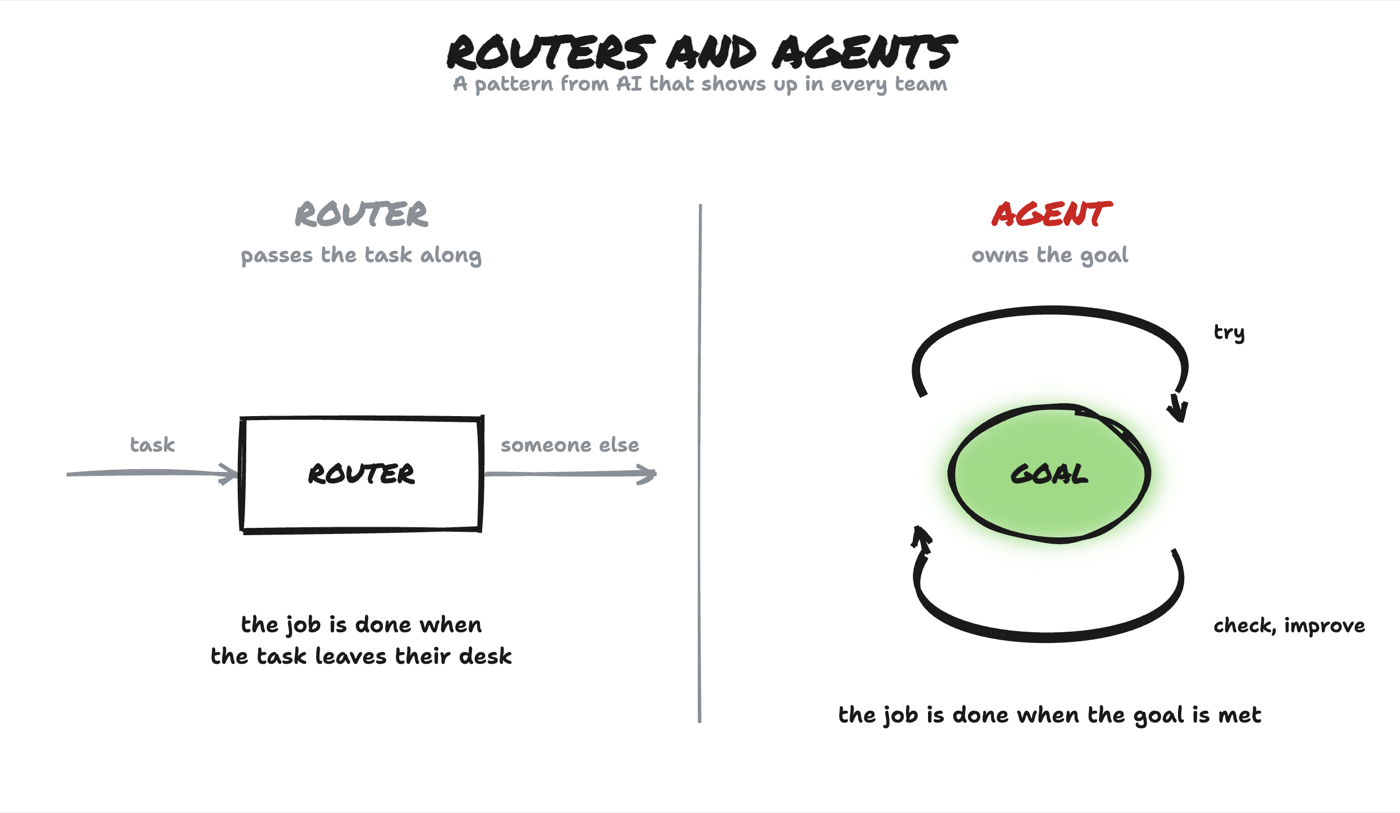
You can't build a company out of routers. You need agents.
Running a business like an agent builder
The biggest shift came a few months later. I realized that running a business is starting to look a lot like improving agents.
Say a thousand support requests come in. The old way is to manage all thousand. The new way is to improve the agent until it can handle more and more of them on its own.
You let the agent propose an answer. You correct it. Then you improve the agent so it gets that kind of request right from then on.
Engineers call the scoring part an eval: a test that measures how well the AI is doing, so you can see whether each change makes it better or worse.
It works the same way for sales, for marketing, and for nearly everything else a business does. You stop doing the work and start improving the system that does the work.
The takeaway
I went in to learn a technology. I came out with a better way of thinking:
- Treat any job as a system with a clear goal.
- Build in a feedback loop so the work checks itself.
- Break big problems into small steps.
- Don't stop at the first draft: generate, grade, improve.
- Work like an agent, not a router, and hire people who do too.
The best way to build intelligent machines turns out to be a pretty good way to become more intelligent yourself.