Marketing Funnels from First Principles
Most people build a marketing funnel like this...
They find a template somebody else used, copy the steps, and cross their fingers.
Sometimes it works!
But when it doesn't?
They have no idea why. So they grab another template...
and start all over again.
I know, because I did it for years.
There's a much better way. And it comes from how engineers think:
First principles.
So what is "first principles" thinking?
It means breaking a problem down to the basic truths you're sure of...
and building back up from there, instead of copying what everybody else does.
And when it comes to funnels, the first basic truth is simple:
A funnel is a system.
Funnels are systems
A system is just a set of parts working together to turn an input into an output.
Take a chair. Legs, a seat, a back... each one is pretty useless on its own. But put them together, and they turn discomfort into comfort.
A funnel works the same way.
Its goal is a lead or a sale. Its input is traffic (people who are only a little bit interested). Its output is leads and customers: people who went from barely interested to ready to buy.
Now here's the part that changes everything...
Funnels are made up of systems inside systems. Kind of like Russian nesting dolls. For example:
- The funnel is made of pages, emails, and text messages.
- Each page is made of sections: the headline, the problem, the solution, the proof, the offer.
- Each section is made of elements: the words, the images, the button.
- ...and so on!
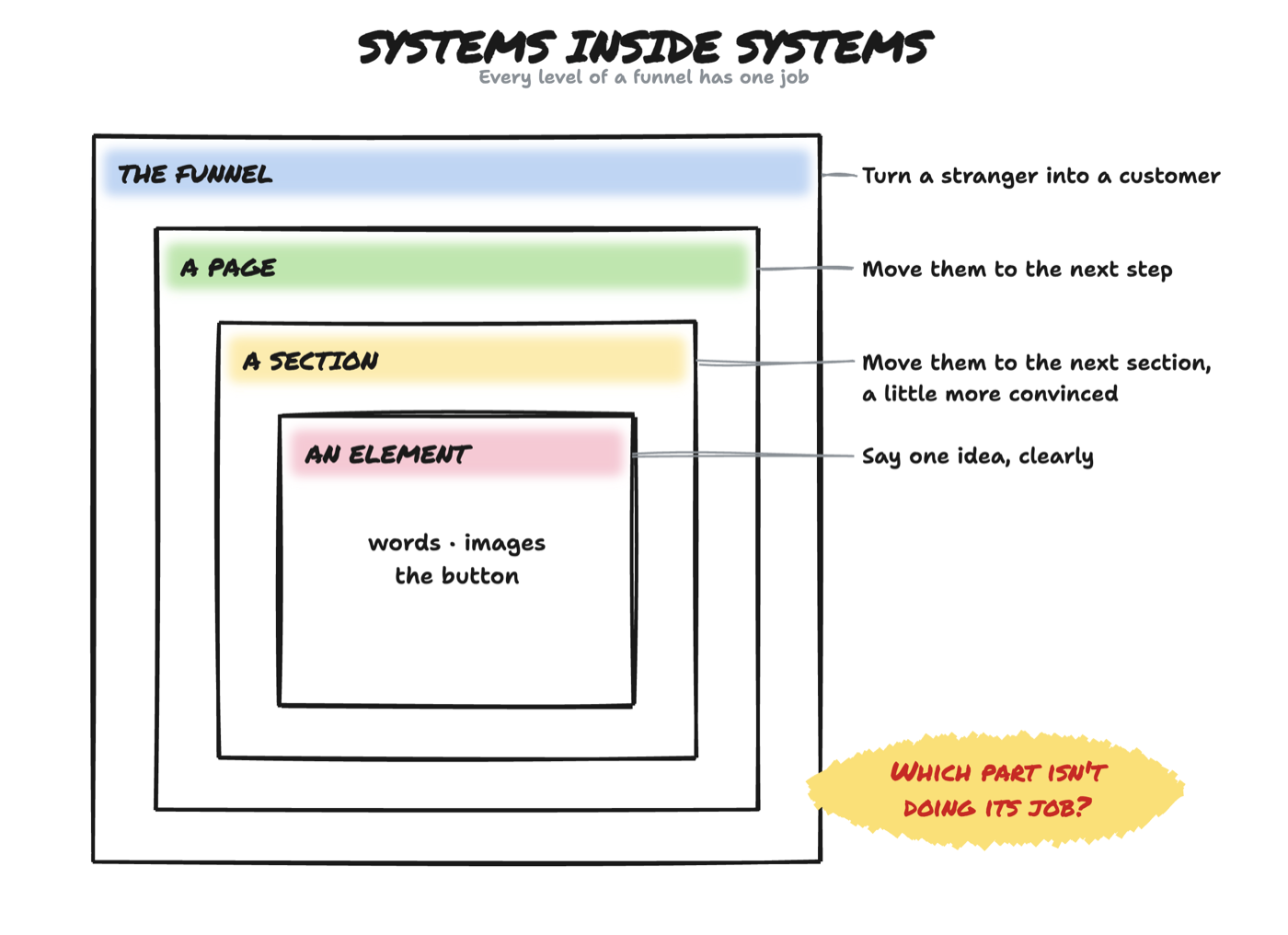
And every single level has one job.
A section's job is to move the reader to the next section, a little more convinced than before. A page's job is to move them to the next step of the funnel.
Once you see it this way, you stop asking "why isn't my funnel working?"
...and start asking a much better question:
"Which part isn't doing its job?"
Three tools for improving any system
Engineers have been improving systems for a long time. Three of those tools work especially well on marketing funnels:
1. The 80/20 rule. A small number of parts produce most of your results. In a funnel, a handful of elements matter far more than everything else. That's where your attention goes first.
2. The Theory of Constraints. A system is only as strong as its weakest link. At any moment, there's usually one part holding everything else back. Improve anything else and... not much happens. (I tell the story of how I learned this one in No Teef.)
3. The OODA loop. Observe, orient, decide, act... repeat! It's a decision cycle created for fighter pilots, and it turns improvement into a fast, repeating game. You don't need to be perfect on day one. You just need to cycle fast.
Put all three together and you get something simple and powerful:
Build only the parts that matter. Find the weakest one. Fix it. Go around again, as fast as you can.
Rebuilding a dead funnel, brick by brick
It's the same process I used to double the results of a webinar funnel that was underperforming.
Instead of tossing it and starting over, I broke it down to its raw ingredients...
and rebuilt it, one piece at a time, checking every part against the job it was supposed to do and patching every hole I found.
Here's the order I'd recommend:
- Start with the simplest version that can work. I call this a core funnel. It only has to do three things: get attention, shift a belief or two, and make the sale. Everything else can wait!
- Measure every step. Accurate tracking is non-negotiable. Without it, you're right back to guessing.
- Compare each step to a benchmark. Whichever step falls furthest short is your constraint.
- Fix the constraint first. Start with proven best practices, then split-test fresh ideas once the basics are in place.
- Repeat! When one constraint is fixed, another becomes the weakest link. That's your next job.
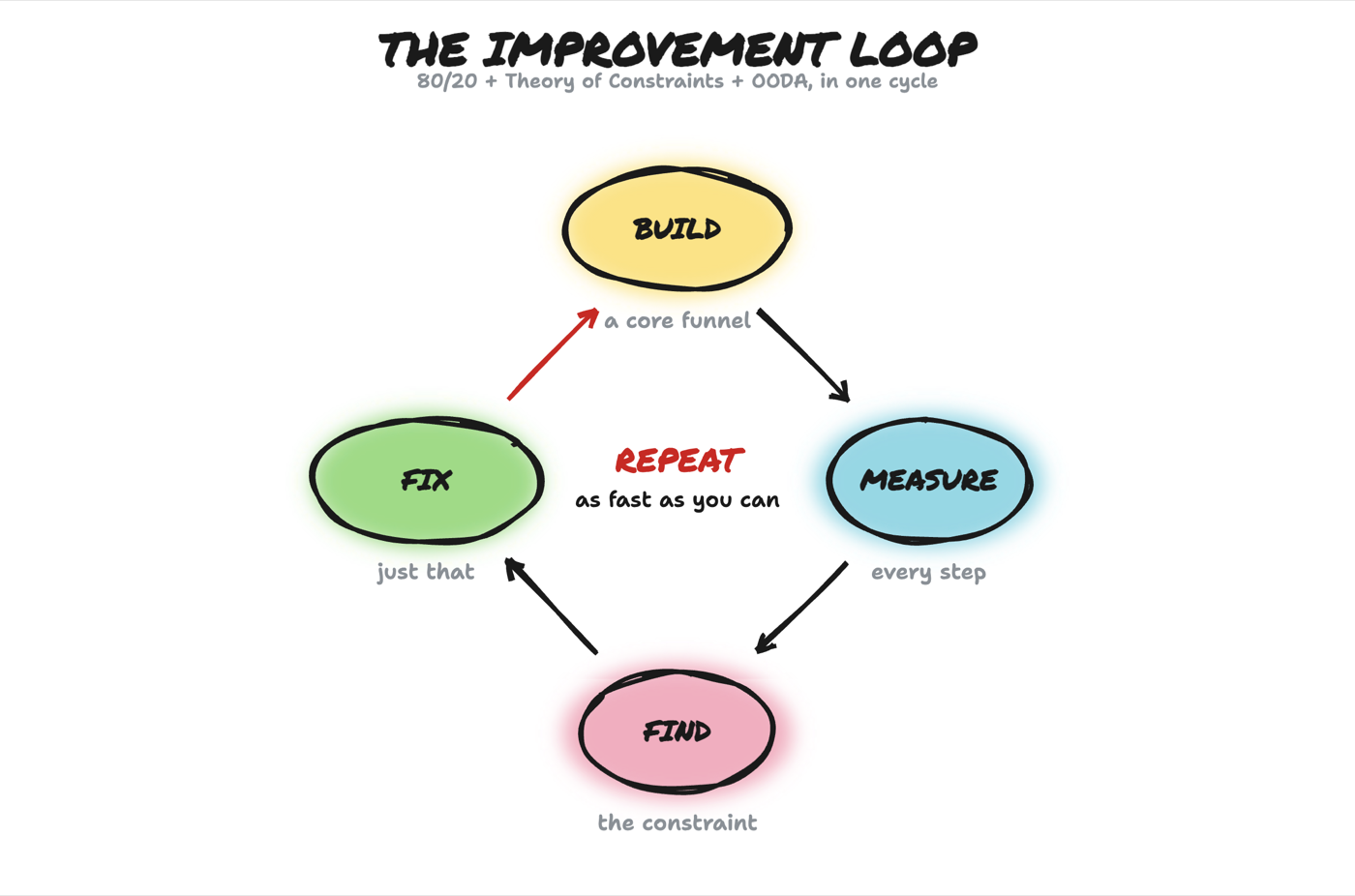
Keep it simple. The goal is core funnel success before you add anything fancy.
Once that simple version works...
that's when split testing starts to pay off. You're testing small improvements on something that already works, and that's how a good funnel becomes a great one.
Why this works
Templates tell you what worked for someone else, in their market, at one moment in time.
First principles tell you why a funnel works at all.
And once you understand the why, you can diagnose any funnel, in any market...
and fix it!
If you want the complete method, it's in my upcoming book, The Future of Marketing.